I continue to be excited with the progress that professor Snowden-Ift and the solar committee are making on this project. I just learned in class that there will be a campus wide briefing on Wednesday October 21st at 4:30-5:30. So please let your friends know about this meeting, and hopefully you can attend. Getting the word out to the greater Occidental Community is a huge part of this project and will be instrumental in rallying some support for the project. I do feel that the Occidental community is very concerned of the environmental issues we face in the world and will be very supportive of the project. President Vietch has also begun to talk with some of the surrounding community members about the project and this is also a very good sign.
As we begin to move into the phase where this plan is becoming a reality I believe that the Occidental community needs to put great effort into teaching people about benefits of solar power. Once constructed this array will be used as a teaching point for physics classes here at Oxy and local public schools public schools will be allowed to come and use the array to teach their students about solar. I also think it is very important that we outreach to the homeowner community and teach them why solar is important and how it can make their lives better. Outreach to both the community and local homeowners has been discussed and programs are in the making to make this outreach possible. However, outreach to other colleges, universities, large business, etc. about the benefits of installing solar arrays right now has not been discussed. Part of the rationale behind this whole project is that the cost of installing solar panels is at an all time low and the government subsidies are at an all time high, making the choice to go solar a no brainer. So why doesn't Occidental take a leadership role in the greater community and alert other large institutions to the benefits of crossing over to solar at this point in time? Part of me thinks that most colleges and universities probably are aware of the ability to install solar for very cheap and some institutions will find it feasible and do it and others may not take advantage of the situation. In which case our solar array may not be the biggest of any private college in the country for long, but in my opinion that really is unimportant. The other part of me says that maybe these larger institutions don't realize what a great deal installing solar would be at this time and may miss the opportunity. For institutions like these I believe that Occidental needs to be proactive in the greater community of private colleges and universities and show them what we are doing here, and in a sense spread the word about solar. I don't believe that Occidental is the type of institution that will let pride keep such a great secret from helping other institutions switch to more sustainable energy
Thursday, October 15, 2009

Food System Reform Compliments of First Lady Michelle Obama?
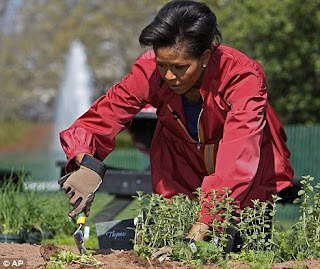
Michelle Obama has planted a garden at the White House, made speeches on eating healthy and is holding "secret meetings" with her policy team and USDA officials. This sounds like a recipe for a food system reform. While most First Ladies do not attempt to make policy recommendations or fail at doing so (i.e. Hillary Clinton's Health Care Plan of 1993), I think Michelle Obama may have a chance at being successful. Nowadays everyone, regardless of socio-economic status, race and age, is paying attention to the quality of food. As we know it is a hard-hitting issue on college campuses across the nation and most are trying to change where college's get their food from or at least educating the student body about food options on campus (plug for food survey, if you have not taken it, take it NOW!). Her policy team consists of White House Food Initiatives Coordinator Sam Kass and Policy Director Jocelyn Frye, who are compiling a new set of national food and health initiatives. Mrs. Obama is developing her "policy" around former FDA chief David Kessler's new book, The End of Overeating. The book states that sugar, fat and salt are addictive and America is addicted to them. I think it would be amazing if the First Lady rather than the President reformed our food system that affected not only the infrastructure in schools but also in households. It will be interesting to see how this takes form throughout Obama's term and if Michelle is not successful, I hope someone is.
The future of sustainability at Oxy
In thinking about the future of Occidental's campus greening movement, I find myself focusing on the "little things" that the college could do to achieve sustainability. While I am happy that our administration has proven to take some initiative to make our school more eco-friendly, namely by supporting the solar array proposal and agreeing to have all new buildings and renovations meet the silver standard of the Leadership in Energy and Environmental Design (LEED) green rating system, I wonder if we, as an educational institution, shouldn't be spending more time trying to instill a greater sense of responsibility among the members of our student body--aka the future leaders of this country. After all, how does Occidental plan on becoming a leader among other green campuses, if the very members of its student body are unwilling to shut off their lights?
I think one of the roots of our environmental crisis is our general unwillingness to change our ways. It's easiest to jump onboard in support of large projects like the installation of solar panels or green building designs, especially since showing your support these days is just a click away by accepting a group invitation on Facebook. But would we go so far as to give up parts of our comfortable and somewhat selfish lifestyles just for the sake of the planet? Some may say Yes, but the answer of many is unfortunately probably not.
We live in a world where incentives govern our actions. If the benefits of our actions aren’t tangible-if we can’t reap them immediately—then it’s unlikely that the majority of people will be willing to incur the costs of changing our ways. When people, who live less than a block from campus, drive to school they are not thinking about their carbon footprint, but something more along the lines of “I’m so late for class.” When we fail to turn our lights off before leaving the house, we comfort ourselves by thinking “at least someone will think I’m home so no one will break in.” How many people do you know actually unplug their appliances when not in use? Something as simple as that could curtail 5% of America’s energy use.
I looked at these sites to learn more easy and low cost ways on how to reduce our footprint:
http://ase.org/section/program/greencampus
http://energy.gov/energysavingtips.htm
Some of these “little things” are way too easy to accomplish, but what sort of incentives is the college willing to give us to do them? Will our efforts to conserve energy reflect themselves in lower tuition? Probably not…so the question remains, how do we change the attitude of not just Oxy students but of the world at large?
Marketplace Reform!
So, talking about all the energy, effort, and money that is going into the solar panel got me thinking about ways to make our school green. Of course the solar panel is a huge project that will have a big impact environmentally as well as economically. It will also bring attention to our school and maybe make it more appealing to future students.
However, I think small efforts should also be welcomed, efforts in which the students can have a say and a part. I was recently reading an article about ways in which some colleges have tried to go green, and I found a particular thing that caught my attention: Biodegradable utensils and reusable to-go containers. This caught my attention, because it is such a simple thing, that must of us don’t think about it, even while we are pouring food on our plastic containers. Currently the market place has plastic utensils and plastic to-go containers. On average people get food to go at least two times a week, making use of these plastic containers and then just throwing them away. This is a huge waste, both environmentally and economically.
As a solution to this problem, one of the colleges introduced the use of the Eco-Clamshell. This is a plastic container that can be reused, put in the microwave and the dishwasher. Students are given one box, and each time they go to the cafeteria they have to bring it with them, they exchange the used one for a clean one at the front and then get all the food they want. Now I realize that this system might need a lot of work to begin with (purchasing the Eco-Clamshells, changing the marketplace structure to accommodate the new system, etc), but once implemented the benefits will start to show. Another thing being implemented across campuses is the use of “Tater-Ware.” Like the name suggests, the Tater-Ware coffee lids are made from potatoes. The lids, as well as the Ecotainer coffee cups, are petroleum-free, and can break down over time in compost piles. And given the fact that we already have a compost pile on campus, the use of the “Tater-Ware” would be a great idea.
Also, the use of trays at the marketplace, wastes a lot of water. It would not be that hard for students to survive without trays and we would be saving the school a lot of money in electricity and water and helping the environment.
Now, I think all these ideas are GREAT! And easy to implement if we have the support of the students. Now, I’m not going to lie, it might be a little bit of a pain to not have trays at the marketplace or to have to carry your to-go container, but I think we would be able to publicize and promote these changes in such a way that instead of feeling like a pain they feel like something new and innovative that our school is doing. We can make the students feel like they are part of a progressive movement and make them feel excited about it.
*Kliah*
However, I think small efforts should also be welcomed, efforts in which the students can have a say and a part. I was recently reading an article about ways in which some colleges have tried to go green, and I found a particular thing that caught my attention: Biodegradable utensils and reusable to-go containers. This caught my attention, because it is such a simple thing, that must of us don’t think about it, even while we are pouring food on our plastic containers. Currently the market place has plastic utensils and plastic to-go containers. On average people get food to go at least two times a week, making use of these plastic containers and then just throwing them away. This is a huge waste, both environmentally and economically.
As a solution to this problem, one of the colleges introduced the use of the Eco-Clamshell. This is a plastic container that can be reused, put in the microwave and the dishwasher. Students are given one box, and each time they go to the cafeteria they have to bring it with them, they exchange the used one for a clean one at the front and then get all the food they want. Now I realize that this system might need a lot of work to begin with (purchasing the Eco-Clamshells, changing the marketplace structure to accommodate the new system, etc), but once implemented the benefits will start to show. Another thing being implemented across campuses is the use of “Tater-Ware.” Like the name suggests, the Tater-Ware coffee lids are made from potatoes. The lids, as well as the Ecotainer coffee cups, are petroleum-free, and can break down over time in compost piles. And given the fact that we already have a compost pile on campus, the use of the “Tater-Ware” would be a great idea.
Also, the use of trays at the marketplace, wastes a lot of water. It would not be that hard for students to survive without trays and we would be saving the school a lot of money in electricity and water and helping the environment.
Now, I think all these ideas are GREAT! And easy to implement if we have the support of the students. Now, I’m not going to lie, it might be a little bit of a pain to not have trays at the marketplace or to have to carry your to-go container, but I think we would be able to publicize and promote these changes in such a way that instead of feeling like a pain they feel like something new and innovative that our school is doing. We can make the students feel like they are part of a progressive movement and make them feel excited about it.
*Kliah*
Campus Dining Suppliers
Another great couple weeks of eating. Wellfed the saturday before last was UNBELIEVABLE!
I did some research on the websites of the companies our campus dining patronizes. There is definitely room for improvement. As far as I could tell Driftwood Dairy has a pretty good ecological reputation and they are located pretty close to Oxy. Meyer Natural Angus Beef is hormone free (but not free range or grass fed), most of our seafood is sustainably harvested, and a lot of the other websites claimed to be 100% organic. However, it's really difficult to a) sort through all the misleading bullshit on the websites and b) figure out how the relative proportions we buy from each supplier. So while a lot of our companies claim to be organic, sysco is not, and I have a feeling they are the most major source. I looked at Pamona college, they got an A- on their green report card and their main supplier or Cysco equivalent is Sodexho which has one numerous green ethics awards. Also, none of our coffee is fair trade and I couldn't figure out where we get our poultry and eggs, so I don't know if they are cage free or not.
Here are the suppliers:
Cakery Bakery (Special Events
Dr. Soda
Also, I found that nutritious vending machines are on the rise. I wonder how difficult it would be to make a switch to something like this:
I did some research on the websites of the companies our campus dining patronizes. There is definitely room for improvement. As far as I could tell Driftwood Dairy has a pretty good ecological reputation and they are located pretty close to Oxy. Meyer Natural Angus Beef is hormone free (but not free range or grass fed), most of our seafood is sustainably harvested, and a lot of the other websites claimed to be 100% organic. However, it's really difficult to a) sort through all the misleading bullshit on the websites and b) figure out how the relative proportions we buy from each supplier. So while a lot of our companies claim to be organic, sysco is not, and I have a feeling they are the most major source. I looked at Pamona college, they got an A- on their green report card and their main supplier or Cysco equivalent is Sodexho which has one numerous green ethics awards. Also, none of our coffee is fair trade and I couldn't figure out where we get our poultry and eggs, so I don't know if they are cage free or not.
Here are the suppliers:
Cakery Bakery (Special Events
Dr. Soda
Dreyers Grand Ice Cream
Driftwood Dairy
EnviroTech (Green Cleaning Products)
Farmer Brother's
First Class Vending (Vending Machines throughout Campus)
Fosselman's Ice Cream (Tiger Cooler)
Gavina Coffee (Tiger Cooler)
Goldberg & Solovy Foods
The Growers' Collaborative
HannahMax Baking
Healthy Baking Company (Tiger Cooler)
The Individual Group (Paper Products)
Kikka Sushi (Tiger Cooler)
Le Chef Bakery
Meyer Natural Angus Beef (Marketplace and Tiger Cooler burgers)
Mutual Trading Company
Naked Juice (Marketplace)
Nature's Best
Oliver's Artisan Breads (Marketplace)
Organic to Go (Coffee Cart)
Otis Spunkmeyer
Pura Vida Coffee (Coffee Cart)
Rossmoor Pastries (Special Events)
Sparkletts Water
Swiss Chalet
Sysco
Taylor Maid Farms Coffee (Marketplace)
Trellis Earth (Corn-based Plastics)
United Natural
Also, I found that nutritious vending machines are on the rise. I wonder how difficult it would be to make a switch to something like this:
| ||||||||||||||||||||||||||||||||||||

What a Powerful and Meaningful Site
Many students of Occidental College and residents of the surrounding area have had the opportunity to interact with the area known locally as "Mount Fiji." There are great trails that lead to the top of this "mountain" in our little community. At the top one finds great panoramic views of Los Angeles and on an absolutely perfect day a magnificent site of the Pacific Ocean. But what does this all have to with Oxy's plan to build the largest single solar array in Los Angeles?
Well many may fear that this proposed project would limit the ability for both residents and students to take advantage of this local mountain top. In order to put this notion to rest I myself traveled and explored the desolate area known as "Mount Fiji." After studying the proposed sites for the solar area I was able to grasp the idea of the proposed appearance and size of the solar panels. My trek to the top of this hillside was but just a mere dirt path, but this dirt path has been incorporated into the project and absolutely will remain. So all access to the hillside will not be deterred by this project. The site from the top of the mountain is still as wondrous as I had remembered. Looking down the south side, the proposed site for the solar array, I noticed that the desolate area can hardly be seen from my position. I also noticed that the accessibility to the site was currently very minimal. This reinforced my notion that this was a good site for the solar array. After taking a few minutes at the top I continued on to explore the actually site of the project. I noticed that once again the dirt path leading to the top was the only real route that ran through the area of the proposed solar project, and as I stated earlier this path will not be hindered by the project. Coming down the hillside I took a few moments to gaze at the land that might possibly supply our college with almost a third of all our energy needs. The site that would showcase Oxy as a sustainable and environmentally conscience college. The site that would become a trademark of the initiative our college took to ensure a better future for our world. Standing there with all these thoughts running through my mind I felt a great sense of pride about the direction our college wants to move. This moment was powerful and it truly clinched, in my mind, that this project was worth the immediate cost and was something that we didn't just need to do but something that we must do. I stood back and though what a powerful and meaningful site this will be.
Well many may fear that this proposed project would limit the ability for both residents and students to take advantage of this local mountain top. In order to put this notion to rest I myself traveled and explored the desolate area known as "Mount Fiji." After studying the proposed sites for the solar area I was able to grasp the idea of the proposed appearance and size of the solar panels. My trek to the top of this hillside was but just a mere dirt path, but this dirt path has been incorporated into the project and absolutely will remain. So all access to the hillside will not be deterred by this project. The site from the top of the mountain is still as wondrous as I had remembered. Looking down the south side, the proposed site for the solar array, I noticed that the desolate area can hardly be seen from my position. I also noticed that the accessibility to the site was currently very minimal. This reinforced my notion that this was a good site for the solar array. After taking a few minutes at the top I continued on to explore the actually site of the project. I noticed that once again the dirt path leading to the top was the only real route that ran through the area of the proposed solar project, and as I stated earlier this path will not be hindered by the project. Coming down the hillside I took a few moments to gaze at the land that might possibly supply our college with almost a third of all our energy needs. The site that would showcase Oxy as a sustainable and environmentally conscience college. The site that would become a trademark of the initiative our college took to ensure a better future for our world. Standing there with all these thoughts running through my mind I felt a great sense of pride about the direction our college wants to move. This moment was powerful and it truly clinched, in my mind, that this project was worth the immediate cost and was something that we didn't just need to do but something that we must do. I stood back and though what a powerful and meaningful site this will be.
Getting Some Local Help
Last week, Chris Suzdak and I met with Oxy's Director of Risk Management, Rebecca Dowling about the safety/insurance-related hurdles associated with establishing a bike-sharing program on campus. As Chris mentioned in his blog post, Dowling is no stranger to student efforts to get kids on bikes. In previous attempts, overambitious costs and skeletal proposals prevented a go-ahead from administration. Dowling emphasized that our proposal be thorough, containing a detailed description of the system and bike protocol. Before we begin writing, we need to confirm the library's cooperation (The library's drive to re-envision itself as an "academic commons" seems to be playing into our hand) and assess our bike "fleet" and maintenance strategy.
In regard to evaluating the structural integrity of our bikes and keeping them safe I think the Bike Oven is a valuable asset. The Bike Oven (http://bikeoven.com/) or (323 223 8020) is a bicycle repair Co-op located at 3706 N. Figueroa street. With a “do-it-yourself” mission, the Bike Oven allows bicyclists to come in and receive personal instruction from the staff in fixing their bikes for 5$ a day. The Bike Oven provides all the tools as well as information on organized group rides around Los Angeles. I emailed a volunteer at the “oven,” John Harvey. I was curious if they had experience working alongside up-and-coming bike-sharing programs and whether they could give us a leg-up deciding if our acquired bikes are worth fixing and, if so, helping us fix them. Harvey’s response was incredibly promising – proposing two possible options. The first is that we can bring in the bikes, receive training for their repair, and potentially pay for our time there using parts removed from bikes not worth fixing. The alternative would be to trade 8-12 of our neglected bikes and our group's available time to volunteer at the Bike Oven, for a few of the Bike Oven's already ready-to-ride bikes, giving us a 'quick start' on our bike sharing fleet. This option seems surprisingly generous and something we may want to take advantage.
Sometime soon, I think a few of us from the alternative transportation team should make an effort to visit the Bike Oven. It is also important that we find out how regular a responsibility repairing our bikes will be. If a dozen bikes require frequent maintenance, we may want to look into establishing a minimal hour paid position at the “Cage” – working title for our Range view bike corral. In any event, we’re making great strides. Once we inherit out bikes, we’ll have a firmer grip on our situation and can move on accordingly with the Bike Oven and begin to start putting pen to paper for our proposal.
In regard to evaluating the structural integrity of our bikes and keeping them safe I think the Bike Oven is a valuable asset. The Bike Oven (http://bikeoven.com/) or (323 223 8020) is a bicycle repair Co-op located at 3706 N. Figueroa street. With a “do-it-yourself” mission, the Bike Oven allows bicyclists to come in and receive personal instruction from the staff in fixing their bikes for 5$ a day. The Bike Oven provides all the tools as well as information on organized group rides around Los Angeles. I emailed a volunteer at the “oven,” John Harvey. I was curious if they had experience working alongside up-and-coming bike-sharing programs and whether they could give us a leg-up deciding if our acquired bikes are worth fixing and, if so, helping us fix them. Harvey’s response was incredibly promising – proposing two possible options. The first is that we can bring in the bikes, receive training for their repair, and potentially pay for our time there using parts removed from bikes not worth fixing. The alternative would be to trade 8-12 of our neglected bikes and our group's available time to volunteer at the Bike Oven, for a few of the Bike Oven's already ready-to-ride bikes, giving us a 'quick start' on our bike sharing fleet. This option seems surprisingly generous and something we may want to take advantage.
Sometime soon, I think a few of us from the alternative transportation team should make an effort to visit the Bike Oven. It is also important that we find out how regular a responsibility repairing our bikes will be. If a dozen bikes require frequent maintenance, we may want to look into establishing a minimal hour paid position at the “Cage” – working title for our Range view bike corral. In any event, we’re making great strides. Once we inherit out bikes, we’ll have a firmer grip on our situation and can move on accordingly with the Bike Oven and begin to start putting pen to paper for our proposal.
Subscribe to:
Posts (Atom)
