I remember being really surprised when I learned that there was no fee to park on Oxy’s campus. I had talked to other friends and some of them had to pay up to 400 dollars to park on their campus. I thought I was lucky. But now that I have become more environmentally aware, I don’t think the lack of a parking fee is lucky at all. In fact I think it is a detriment to the college. The environmental impact of parking lots are at least twofold on our campus. First parking indicates the use of cars which contribute to green house gas emissions. Second parking lots reduce the amount of green space available and negatively impact the environment through runoff. Not having a parking fee encourages students to bring their cars to campus and deters the use of alternate transportation methods.
Claremont McKenna College recently reported the top ranking sustainable liberal arts colleges. The colleges selected to be analyzed in the report were the top 50 liberal arts colleges in the nation (based on U.S. News and World Report 2009 rankings). All of the top ten ranking colleges have parking fees and most do not allow freshman students to have a vehicle on campus. For instance Amherst, Williams, and Mount Holyoke have a parking permit fee from 60 to 150 dollars a year. I think Oxy should instate a similar parking fee and follow in the footsteps of Mildbury College,
“Beginning in the 2009-2010 academic year Middlebury College will charge students $50 per semester ($100/year, $25 summer) to park cars on campus. Previously, the college allowed students to register cars without a fee. Middlebury will use funds from this new fee to support its carbon neutrality initiative by distributing revenue between carbon reduction efforts and public transportation, in addition to paying for maintenance of parking lots.”
http://www.middlebury.edu/sustainability/news-events/news/2009/node/117802
A parking fee at Oxy could go to a number of environmental interests; the bike sharing program, zip cars, bus passes, free rides to the airport during breaks, even general parking lot maintenance. This could mean a lot of money towards sustainable projects at Oxy. For instance if 400 students park their car on campus and the fee is 50 dollars per year, that would mean 20,000 dollars. Even if oxy doesn’t institute a parking fee, our website ( like many other colleges) should stress that a car is not needed and that ride sharing or other forms of transportation are preferred.
Showing posts with label sustainability. Show all posts
Showing posts with label sustainability. Show all posts
Friday, March 26, 2010

Thursday, March 25, 2010
CHICKENS!
The Feast garden received a new addition today--baby chickens for their newly built coop! Feast club president, Giovanni Saarman told me in an interview that the new addition of chickens is the first step in what he hopes will be a slow but steady progression in impact and scope of the garden. Saarman provided examples of Oxy's peer schools, like Pitzer College, at which student-run gardens play a more integral role in campus life. Saarman expressed his hopes that FEAST would, in future months and years, take on a similar level of importance in the Oxy community.
One of the needs that many student leaders running FEAST have mentioned in interviews is greater administration support of the garden. Leaders have made clear that administrators support the garden in theory but, for a variety of reasons, the club has been unable to work closely with different offices in order to foster more connectivity between the garden and student services.
While the chickens will be egg-laying in 6 months, club leaders have expressed an interest in working with administrators to bring greater integration of the garden in student life. As it currently stands, the food grown in the garden is consumed and utilized (in the case of compost) by the students who grow it, but the garden has much greater potential than this. If health regulations do not allow for the food grown at the garden to be sold by campus dining outlets then, as is done at Pitzer, the garden can and should be used as part of a larger overall demonstrated commitment to sustainability. Pitzer uses their garden, in conjunction with several other green initiatives, to brand itself as a leader in undergraduate institutional sustainability. Perhaps, in conjunction with the other projects that UEP 247 is currently working on (solar panels, bike sharing, re-usable water bottles, zipcars, etc.) Oxy can take a similar step as its peer institution, and lead the way toward a greener future.
Wednesday, February 24, 2010
Green laundry
Making Occidental College more environmentally friendly is not just about policy change, it is also about teaching students new sustainable behaviors. One activity that can be modified in a green way is doing laundry. This is an activity that every student at Occidental participates in about twice a month. Doing laundry the green way can reduce the colleges energy and water usage. Here are some simple steps anyone can take to make doing laundry more environmentally friendly.
1. Try to always wash your clothes in cold water. Almost 90 percent of the energy is used to heat up the water (the other 10 percent is used to power the motor of the washing machine).
2. Always wash full loads. There are not different size settings on the washing machines at Oxy, so the same amount of water is used regardless of the amount of clothing. Always washing full loads can reduce the number of times you do laundry and save water.
3. Try air drying your clothes. Line drying will save a lot of energy and will make your clothes last longer. Line drying can also reduce wrinkles. I found a folding rack on target's website for only $ 20.00. For a less expensive method, I just use hangers around my room.
Most of the information I found about green laundry practices came from Pomona Colleges’ website for sustainable living in college. Their college has an excellent program to promote sustainability at an individual level. Each student is able to check out a foldable drying rack, an endless supply energy efficient light bulbs, and a small odorless composter. In terms of encouraging green laundry practices the college recently installed drying racks in every laundry room. While the website does not seem to be functioning many other colleges have started offering students personal foldable drying racks, such as the University of Missouri. Hopefully Oxy students can embrace doing laundry in an environmentally friendly way to help reduce energy use on campus.
1. Try to always wash your clothes in cold water. Almost 90 percent of the energy is used to heat up the water (the other 10 percent is used to power the motor of the washing machine).
2. Always wash full loads. There are not different size settings on the washing machines at Oxy, so the same amount of water is used regardless of the amount of clothing. Always washing full loads can reduce the number of times you do laundry and save water.
3. Try air drying your clothes. Line drying will save a lot of energy and will make your clothes last longer. Line drying can also reduce wrinkles. I found a folding rack on target's website for only $ 20.00. For a less expensive method, I just use hangers around my room.
Most of the information I found about green laundry practices came from Pomona Colleges’ website for sustainable living in college. Their college has an excellent program to promote sustainability at an individual level. Each student is able to check out a foldable drying rack, an endless supply energy efficient light bulbs, and a small odorless composter. In terms of encouraging green laundry practices the college recently installed drying racks in every laundry room. While the website does not seem to be functioning many other colleges have started offering students personal foldable drying racks, such as the University of Missouri. Hopefully Oxy students can embrace doing laundry in an environmentally friendly way to help reduce energy use on campus.
Thursday, November 19, 2009
Ramblings on Our Societal Condition
Recently, I got a headache after eating in the Marketplace. It wasn't the type of headache I was used to, and I had been feeling perfectly normal before the meal. I was well-rested, had even worked out the day before, the sun was shining; everything was great. So it puzzled me when a half hour later I was lying in bed, feeling crappy. It wasn't until then that I began to wonder what could have caused the situation. I thought back to what I had eaten; nothing terribly unhealthy as far as I could remember. The only thing unusual had been soy sauce. Dun dun dunnnn, the soy sauce. That's what had done it. I looked up the ingredients and low and behold! one of the byproducts of the fermentation process is mono-sodium glutamate (MSG). I knew that MSG and I don't typically get along, but I just hadn't thought about it before deciding to pour soy sauce all over my meal. The incident got me thinking about food and what it is we're putting into our bodies.
Even the most basic aspects of our lives are removed from our awareness. For instance, I don't really know anything about the food I consume. Who grew it? Where did it come from? What chemicals were used on it? I'm sure even as little as one hundred years ago (ok, maybe two hundred), this kind of ignorance was unheard of. People used to grow and raise their own food. Yes, I realize that things have changed in the name of progress and convenience, but I wonder if it has been a good thing. What have we really gotten out of this system? As a country, obesity levels have increased at an alarming rate. Only Colorado has a prevalence rate of less than 20% (http://www.cdc.gov/obesity/data/trends.html). Childhood diabetes is common as McDonalds. It's getting scary.
And it's not just food. Think about clothing, toiletries, notebooks, computers, the list goes on. Essentially every material object we possess came from somewhere. Every single item has a back story, from being grown overseas, shipped somewhere else to be processed, sent to a warehouse, and then distributed to stores, where people can drive over and pick one up for themselves (Yay!). How much CO2 was produced for me to have the pen sitting next to me? What rain forest was cleared, how many animals displaced for me to have this notebook? It's funny, but I wish for the time when people made their own things. I don't know if it's possible to be nostalgic about something I've never actually experienced, but that's as close as I can get to describing the feeling.
The other thing that keeps coming to mind is the Western concept of waste. Generally, people of Western cultures see time in a strictly linear way. You're born, you live, you die, the end. People see trash the same way; once you're done, you throw it away and it's gone forever. Wrong. When you throw something away, it's simply being sent somewhere else. It is still just as much in existence as you or me, it's still taking up space. This contrasts to a more Eastern philosophy, especially prevalent in Hinduism. Though I myself am not Hindu, I've learned a little bit about it and can really appreciate its teachings on reincarnation and the cyclical nature of time. This results in much more balanced (and sustainable) practices when it comes to consumption and waste. (In theory, at least; I'm not going to tell you that places where most people are Hindu aren't polluted). The Iroquois also had similar notions. Within their rules for governing it was stated that before a decision could be made, it's impact on the next seven generations must be reviewed. This kind of thinking is ideal when it comes to sustainable practices. I'm not really sure where I'm going with this, or how this can be utilized, but I've just been thinking about it a lot recently. Overall, people need to stop placing so much importance on convenience now, and start looking at the big picture.
And it's not just food. Think about clothing, toiletries, notebooks, computers, the list goes on. Essentially every material object we possess came from somewhere. Every single item has a back story, from being grown overseas, shipped somewhere else to be processed, sent to a warehouse, and then distributed to stores, where people can drive over and pick one up for themselves (Yay!). How much CO2 was produced for me to have the pen sitting next to me? What rain forest was cleared, how many animals displaced for me to have this notebook? It's funny, but I wish for the time when people made their own things. I don't know if it's possible to be nostalgic about something I've never actually experienced, but that's as close as I can get to describing the feeling.
The other thing that keeps coming to mind is the Western concept of waste. Generally, people of Western cultures see time in a strictly linear way. You're born, you live, you die, the end. People see trash the same way; once you're done, you throw it away and it's gone forever. Wrong. When you throw something away, it's simply being sent somewhere else. It is still just as much in existence as you or me, it's still taking up space. This contrasts to a more Eastern philosophy, especially prevalent in Hinduism. Though I myself am not Hindu, I've learned a little bit about it and can really appreciate its teachings on reincarnation and the cyclical nature of time. This results in much more balanced (and sustainable) practices when it comes to consumption and waste. (In theory, at least; I'm not going to tell you that places where most people are Hindu aren't polluted). The Iroquois also had similar notions. Within their rules for governing it was stated that before a decision could be made, it's impact on the next seven generations must be reviewed. This kind of thinking is ideal when it comes to sustainable practices. I'm not really sure where I'm going with this, or how this can be utilized, but I've just been thinking about it a lot recently. Overall, people need to stop placing so much importance on convenience now, and start looking at the big picture.
Wednesday, November 18, 2009
How to turn Oxy's C into an A!
In the last few weeks, I've been getting more and more excited about Zipcar and bike sharing programs. Despite quite a few bumps in the road, we're finally nearing the end (or the beginning?) of the Zipcar saga. With the support of risk management and several other key administrators, the only step left is to get approval from the Cabinet. With amazingly positive survey results and not many reasons to say no, the future is looking bright for car-sharing! Although there are a few more hurdles for the bike sharing program, that's looking good as well. It's incredible that after just a semester of hard work, we can potentially get both alternative transportation programs on campus.
It seems that the rest of the campus is moving towards sustainability on its own, as well. After installment of bike racks, the number of bikes on campus has exploded. In addition, a large number of my friends are considering bringing their bikes to campus next semester (or, hopefully, will be avid users of the new bike sharing program!) This snowball effect could easily turn Oxy from its current car-centrism to a campus where Zipcars, bikes, and good old-fashioned legs are the new norm for transportation around our urban environment.
But as much as I want to celebrate the work that has been done by both my group and individual Oxy students, I'm amazed by how much work is yet to be done to make this college truly sustainable. As important as it is to recognize the current accomplishments of the College towards a 'green' campus, we also need to begin to plan what the next steps will be. Judging by how long it took to get Zipcar, pre-existing program, approved at Oxy (thus far, unofficially approved), brainstorming and work for future projects should begin as soon as possible.
What other projects could Oxy students pursue in order to improve our college's sustinability? Here's my brainstorming below - feel free to post your own ideas in a comment!
- Start a composting program. We could start with just the Green Bean, and perhaps slowly expand to the Cooler, Marketplace, and even the dorms. I started a composting program at my high school, and it was surprisingly easy, even for a school of 700 students + faculty/staff. Composting usually involves an extra receptacle for non-animal product food scraps, compostable cups and plastic containers, and food-soiled paper products, like napkins. Our contracted trash collecting company likely works with composting as well; if not, there are a good number of other compost-collecting companies in the LA area.
- Add hand dryers to all bathrooms on campus (including dorms). This may seem like a small gesture, but I always hate seeing the thousands of paper towels thrown into the garbage each week.
- Make our landscaping more sustainable. Replacing water-sucking non-native plants with some local, natural growth would decrease our water usage, which is currently astronomical (70% of our total water usage on campus comes from watering!)
- Keep working towards getting solar and more local and organic foods at our dining halls.
-Get rid of the leaf blowers! They're pretty much pointless, and awful for the environment. If the administration insists on getting rid of fallen leaves, would it be so awful to use a rake??
- (this is a little wishful, but...) Turn Rangeview into an energy-generating gym! We could also do this with the gym they're planning on installing in Alumni gym. If people are already working out, we might as well get some free energy from it!
Judging from the level of excitement surrounding local foods month, the potential solar array, Zipcars, and bike sharing, Oxy students are willing to help make campus sustainability a reality. Post your ideas below OR, better yet, apply for funding to make it happen!
http://clubs.oxy.edu/asoc/sustainability.htm
Thursday, October 22, 2009
Tweeting Your Way to Local and Organic Food in LA
With the absurd amount of taco trucks, Los Angeles has created its own mobile food industry. Offering cheap food almost anywhere, taco trucks have served our late night munchies well. Recently, with customers following the Koji Korean BBQ truck like groupies on twitter crack, a new market of alternative mobile food is being created. Along with this increase in alternative taco trucks, there has also been the introduction of sustainable mobile food providers through out the greater Los Angeles area. These eateries are making me wonder, should we tweet to our next free range beef burrito?
Let’s take a look at the sustainable food trucks showing up around LA:
 Let’s Be Frank: It’s goal: to change the world one hot dog at a time. It’s method: Selling only locally raised grass fed beef hot dogs and sausages. Follow Let’s Be Frank on twitter @letsbefrank
 Green Truck on the Go: Serves organic/local food, uses compostable to go plates/cups/utensils and uses vegetable oil as fuel. These Green trucks have been showing up in New York and Los Angeles. Follow Green Truck at @green truck
 Border Grill: Brought to you by the founders of Sustainable eatery Border Grill and Ciudad, this taco truck serves sustainable Mexican cuisine. follow them on the twitter @bordergrill.
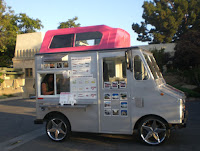 Cool Haus: Can’t hear the music of the ice cream truck? Look no farther! Cool Haus offers handmade ice cream sandwiches with locally and organically sourced ingredients. Follow Cool Haus @COOLHAUS
 Sprinkles Mobile: Your favorite cupcake is on the go and green friendly! The mobile truck offers Sprinkles’ famous cupcakes with packaging and wrappers made from recyclable material and donates leftovers to food banks each day. twitter @ http://twitter.com/sprinklesmobile.
 Divine Nourishment: Committed to minimizing use of plastic bags and prepackaged foods, using all organic ingredients, buying local produce and using biodiesel to fuel the vehicles, this truck provides tasty and sustainable food on the go. twitter @organicgoodness
Are these trucks truly sustainable as they drive around Los Angeles selling to an upper class taco truck customer? Some use bio fuel while others simply commit to reducing waste, but all of these trucks are spreading the word about the importance of sustainable food practices and representing the growing demand for healthy food choices in Los Angeles. Though these gourmet trucks may in the future compete with current taco trucks for customers, it seems more likely that a new market of mobile food is about to develop with the inclusion of sustainable eateries. Will we see Leo’s offer a free range chicken quesadilla in the future? Only time will tell. Until then, tweet your heart out and enjoy some environmentally friendly food on the go.
Let’s take a look at the sustainable food trucks showing up around LA:
 Let’s Be Frank: It’s goal: to change the world one hot dog at a time. It’s method: Selling only locally raised grass fed beef hot dogs and sausages. Follow Let’s Be Frank on twitter @letsbefrank
  Green Truck on the Go: Serves organic/local food, uses compostable to go plates/cups/utensils and uses vegetable oil as fuel. These Green trucks have been showing up in New York and Los Angeles. Follow Green Truck at @green truck
 Border Grill: Brought to you by the founders of Sustainable eatery Border Grill and Ciudad, this taco truck serves sustainable Mexican cuisine. follow them on the twitter @bordergrill.
 Cool Haus: Can’t hear the music of the ice cream truck? Look no farther! Cool Haus offers handmade ice cream sandwiches with locally and organically sourced ingredients. Follow Cool Haus @COOLHAUS
 Sprinkles Mobile: Your favorite cupcake is on the go and green friendly! The mobile truck offers Sprinkles’ famous cupcakes with packaging and wrappers made from recyclable material and donates leftovers to food banks each day. twitter @ http://twitter.com/sprinklesmobile.
 Divine Nourishment: Committed to minimizing use of plastic bags and prepackaged foods, using all organic ingredients, buying local produce and using biodiesel to fuel the vehicles, this truck provides tasty and sustainable food on the go. twitter @organicgoodness
Are these trucks truly sustainable as they drive around Los Angeles selling to an upper class taco truck customer? Some use bio fuel while others simply commit to reducing waste, but all of these trucks are spreading the word about the importance of sustainable food practices and representing the growing demand for healthy food choices in Los Angeles. Though these gourmet trucks may in the future compete with current taco trucks for customers, it seems more likely that a new market of mobile food is about to develop with the inclusion of sustainable eateries. Will we see Leo’s offer a free range chicken quesadilla in the future? Only time will tell. Until then, tweet your heart out and enjoy some environmentally friendly food on the go.
Thursday, October 15, 2009
What a Powerful and Meaningful Site
Many students of Occidental College and residents of the surrounding area have had the opportunity to interact with the area known locally as "Mount Fiji." There are great trails that lead to the top of this "mountain" in our little community. At the top one finds great panoramic views of Los Angeles and on an absolutely perfect day a magnificent site of the Pacific Ocean. But what does this all have to with Oxy's plan to build the largest single solar array in Los Angeles?
Well many may fear that this proposed project would limit the ability for both residents and students to take advantage of this local mountain top. In order to put this notion to rest I myself traveled and explored the desolate area known as "Mount Fiji." After studying the proposed sites for the solar area I was able to grasp the idea of the proposed appearance and size of the solar panels. My trek to the top of this hillside was but just a mere dirt path, but this dirt path has been incorporated into the project and absolutely will remain. So all access to the hillside will not be deterred by this project. The site from the top of the mountain is still as wondrous as I had remembered. Looking down the south side, the proposed site for the solar array, I noticed that the desolate area can hardly be seen from my position. I also noticed that the accessibility to the site was currently very minimal. This reinforced my notion that this was a good site for the solar array. After taking a few minutes at the top I continued on to explore the actually site of the project. I noticed that once again the dirt path leading to the top was the only real route that ran through the area of the proposed solar project, and as I stated earlier this path will not be hindered by the project. Coming down the hillside I took a few moments to gaze at the land that might possibly supply our college with almost a third of all our energy needs. The site that would showcase Oxy as a sustainable and environmentally conscience college. The site that would become a trademark of the initiative our college took to ensure a better future for our world. Standing there with all these thoughts running through my mind I felt a great sense of pride about the direction our college wants to move. This moment was powerful and it truly clinched, in my mind, that this project was worth the immediate cost and was something that we didn't just need to do but something that we must do. I stood back and though what a powerful and meaningful site this will be.
Well many may fear that this proposed project would limit the ability for both residents and students to take advantage of this local mountain top. In order to put this notion to rest I myself traveled and explored the desolate area known as "Mount Fiji." After studying the proposed sites for the solar area I was able to grasp the idea of the proposed appearance and size of the solar panels. My trek to the top of this hillside was but just a mere dirt path, but this dirt path has been incorporated into the project and absolutely will remain. So all access to the hillside will not be deterred by this project. The site from the top of the mountain is still as wondrous as I had remembered. Looking down the south side, the proposed site for the solar array, I noticed that the desolate area can hardly be seen from my position. I also noticed that the accessibility to the site was currently very minimal. This reinforced my notion that this was a good site for the solar array. After taking a few minutes at the top I continued on to explore the actually site of the project. I noticed that once again the dirt path leading to the top was the only real route that ran through the area of the proposed solar project, and as I stated earlier this path will not be hindered by the project. Coming down the hillside I took a few moments to gaze at the land that might possibly supply our college with almost a third of all our energy needs. The site that would showcase Oxy as a sustainable and environmentally conscience college. The site that would become a trademark of the initiative our college took to ensure a better future for our world. Standing there with all these thoughts running through my mind I felt a great sense of pride about the direction our college wants to move. This moment was powerful and it truly clinched, in my mind, that this project was worth the immediate cost and was something that we didn't just need to do but something that we must do. I stood back and though what a powerful and meaningful site this will be.
Wednesday, October 14, 2009
BIXI for OXY?
The students on the Alternative Transportation Team have begun to realize the multitude of issues that must be addressed in creating a Bike Share program at Oxy. The many types of programs already in place at other institutions and cities combined with the various possibilities here at Oxy create an overwhelming sensation in and of itself. Where to begin? What approach to use? Two major proposals have already been rejected at Oxy in recent years. One proposed, for-profit proposal was too over-the-top, asking the school to purchase expensive bikes and to build a storage structure behind the
Oxy’s Director of Risk Management, Rebecca Dowling, is a crucial authority on the judgment of proposal feasibility. She has seen great ideas created and then rejected because underlying assumptions did not take critical liability issues into consideration. In a recent meeting with her, Mrs. Dowling told Alternative Transportation team members that she is ready to help the project by leading it in the right direction. Her support is a great tool and she said she would be willing to meet regularly. She mentioned that recent projects had also been unable to be finished due to student leaders graduating. It is essential that students realize how much time a project will take and that younger students must get involved to see a project through and be able to see the benefits.
Browsing the internet for other bike rental programs around the world, I found an interesting for-profit bike rental system in
Here’s the BIXI site: http://montreal.bixi.com/home/home-explanation
And here are some pictures of “stations” in


Oxy Admin: Friend or Foe?
After doing some hardcore navigating of the Zipcar website, stalking other small colleges’ sustainability pages for any mention of car sharing, and (finally) talking to the National University Director for Zipcar, I was pumped.
Why so excited? Perhaps I was a little delusional, but after all my research, I thought there was really no way Oxy couldn’t implement Zipcar – or a similar program – on campus. Oxy’s urban, car-centric campus makes a car-sharing program a nearly inevitable student service. Plus, over 130 colleges in the United States – including dozens of small liberal arts colleges – have had great success starting up a Zipcar program on campus. Zipcar even does all the work – Oxy’s only obligation would be $1500/car/month revenue guarantees, which could hopefully be covered by financial support from the Sustainability Fund or other sources on campus. Once these guarantees are met (which often happens after just a few months), Zipcar lifts them – permanently. It seemed like a win-win the Oxy admins should have no problem with: the students would be happier, parking would become less of an issue, and the program may even attract some prospective students. And so, all giddy from talk of Priuses and online reservation systems, I went – with a student ASOC senator – to start casually talking to the Oxy administration.
Needless to say, the meeting didn’t go exactly as I’d planned. In fact, it was downright disheartening.
Clearly, I was a bit delusional to think that such a car-sharing program would be ‘inevitable.’ Unfortunately, Oxy admins – even those who are all for sustainable programs such as Zipcar – aren’t allowed to support these ideas as much as they would otherwise, because of Oxy’s strict policy-making criteria, otherwise known as Always-make-policies-based-upon-the-hypothetical-worst-case-scenario. Technicalities and policy details make implementing any program at Oxy a time-consuming and frustrating process.
Although there were quite a few potential issues listed by administrators regarding the Zipcar program, a primary concern was insurance. Why? One reason was that even though Zipcar provides insurance for all drivers in the program, a student – or someone hit by a student – may sue them if Zipcar insurance doesn’t cover the total accident costs.
Practical? Perhaps. Irrational? I think so. I agree that any school –especially a small school – should be cautious when adopting a new, potentially risky, program. However, programs such as Zipcar and bike-sharing present the opportunity for far more benefits to students than potential costs. Even better, these benefits have already been tested and proven by over one hundred other colleges and universities nationwide. According to economics, and most students, that means that adopting these programs should be a no-brainer.
Hopefully, by my next blog post, I’ll have some great news to share regarding Zipcar. A fellow student (an ASOC senator) and I will be meeting with Rebecca Dowling (the woman in charge of insurance and waivers) and Tim Chang (the new ResLife director) on Friday to go over some Zipcar details. If anyone would like to meet with Annie and I on Friday the 16th before our meeting to give some suggestions or talk about Zipcar, please do so! We’ll be outside the ASOC office from about 11:45-12:45.
Lastly…a few Zipcar photos to get everyone excited!


Thursday, October 8, 2009
Competing for Greening
October is local foods month! As part of the food group we have been distributing and publicizing our survey on campus dining sustainability practices. Judging by our premature results, a significant majority of students (as well as staff) would be willing to spend in the 5-10 or 11-20 % ranges EXTRA for local or organic foods. Is this fact surprising to you? I think this is important for dining services to recognize. Their goal is to get business from students and staff and we are looking for local food! I am excited to see the results after the month is up so we can further analyze them and take steps for change through pressuring dining services and working with them to make sustainable choices.
On another note, this weekend is the Solar Decathlon on the National Mall in D.C. (my home town). The event began in 2002 and happened again in 2005 and 2007. Teams of students from colleges and universities across the globe compete in designing and building the most ‘attractive, effective, and energy-efficient solar-powered house.’ The houses are brought to the Mall for display and the public can go in the houses to see them. Houses must be easy to live in, maintain healthy indoor environmental conditions, adequate lighting, supply energy to household appliances for cooking and cleaning, power home electronics, provide hot water, and balance energy and consumption. They are judged based on architecture, market viability, engineering, lighting design, communications, comfort zone, hot water, appliances, home entertainment and net metering. I think this is a super cool event and got to go into some of the impressive houses in 2007 and learned about the benefits of energy efficiency, renewable energy and green building technologies.

For more information, check out the website: http://www.solardecathlon.org/
I hope that with all our resources on campus from UEPI, this class specifically, other physics/science majors, as well as eager environmental stewards we are capable of participating in this awesome event. Maybe we could buy solar panels at the discount rate when the solar project on campus buys its panels. We could even create a team by combing with other institutions in the area like UCLA, Cal Tech, or the Claremont schools. Do you think it would be possible for Occidental to pull together a team and compete in the future?


Sunday, September 27, 2009
A New Prosperity
I make several trips a day from my room to clear the trash or deposit some recycling. Each time, I attempt to remove some of the wrappers, bags, and other non-recyclable materials from the blue bins and transport them to the trash--where I discover a mountain of used food containers, soda cans, and paper, all of which could have been recycled. I feel not unlike a hobo while digging through the garbage and sorting out its contents, and often have to tamper my urge to put things in their proper place while out in public, so as not appear distasteful. But I resent that I have to choose between helping to minimize waste and maintaining a public image--why cant people just get it right? Or, more importantly, why don't people care about their ecological impact?
Although the impending catastrophes associated with climate change have done much to raise awareness about the repercussions of human activities on the environment, the fact is that our society does not live sustainably and superficial and ancillary adjustments will do little to tamper the destruction. Even if we got all of the recycling right, bought only organic clothes, and switched all our lightbulbs to CFLs, it still would not be enough to "save the planet" because these gestures do not get to the heart of the problem: our society is built upon increasing consumption and economic growth.
Alex Steffen, author of "Planetary Boundaries and the Failure of Environmentalism," (http://www.worldchanging.com/archives/010551.html) urges that, "If planetary boundaries mean anything, they mean it's time to stop pretending that 'greener' is good enough. We need pragmatic brilliance and transformation. Anything less is just cluttering the discussion."
Until our society abandons the long-held Industrial Age idea that the planet's capacity for material growth is infinite, and that the path to prosperity is to accumulate material wealth, we cannot make true progress in the name of sustainability. There is no room for lukewarm efforts--the physical limits of the planet's production deem that the resources for the maintenance of our lifestyle will run out. We must fundamentally change our ingrained habits--more than simply how we go about them--if the world's population is to support itself. "First-world" societies will have to redefine what prosperity is.
I am a hypocrite. I take to-go boxes of salad from the Marketplace on occasion, I'll still drink a Sprite. I recycle them, but I wish I could use a reusable container for all my meals and make my own soda (I actually saw such a device in one of those Skymall magazines--I plan to invest!) But further than this, I too need to consume less and change the way I live. Hopefully campus dining services will help lead the way in exemplifying that our culture needs to seek ways to minimize its environmental impact. Providing reusable containers and local, organic food are a great way to start. I hope, one day, such sustainable changes wont be a politically-laden choice, but a systematic part of our lives. Eventually, we shouldn't have to think about it.
Thursday, September 24, 2009
Every Little Thing Counts
So, I'm going to try to keep this short and simple. Everyone talks about "greening" our campus, through various means, whether it be our up-and-coming bike share program, organizations such as FEAST, or the plans for the installation of solar rays. Granted this is great, no wonderful, that students are excited about making major changes that will positively impact the campus in such dramatic ways. However, I keep getting the sneaking feeling like we're forgetting the details in our excitement.
Seriously though, I am the only person who thinks that simply turning off the lights in the bathroom is also "greening" the campus? There are so many little steps that Oxy could be making that would lessen whatever negative impact we're having. Little things, like making sure you've actually turned the faucet all the way off, flipping lights off if they're not needed, or asking yourself if you really need the air-conditioning on when it's technically 70 degrees outside, could all potentially have huge consequences.
And honestly, it's really not that hard to think about these things. If you just remember how much waste is produced through the process of making all that energy (electricity production creates 2,337.8 Tg CO2 Eq., 33% of total CO2 emissions: http://fatknowledge.blogspot.com/2006/06/co2-emissions-light-bulbs-vs-cars.html), or how much water the process uses (up to 6,000 gallons of freshwater to light a 60 watt light bulb for 12 hours a day for a year - http://www.ecogeek.org/component/content/article/1559), it would seem pretty obvious that conservation is a smart choice. However, I guess it's just our custom to assume that these things are abundant and unlimited. At this point, we need to get out of that mindset.
I really think the campus should maybe look into a campaign for these kinds of simple greening techniques. Something maybe along the lines of, "Turn off the lights, save the planet." (Let me know if that one's already being used, I would hate to plagiarize.) Kinda hokey, but efficient and hopefully catchy enough it stick in people's minds. I'm planning on talking to my RAs about possibly putting up a few signs in the bathroom asking people to make sure the water sources and lights are properly turned off. Also, there are a few bathrooms around campus that have leaky faucets. I saw one in Johnson that looked like it would fill a cup in about 15 minutes, which would come out to about 6 gallons of water over a 24 hour period. Considering how we're facing a global freshwater shortage, I think it would be a good idea to maybe join forces with Maintenance to look into fixing those things. Most faucets seem like they'd need just a little tightening, which a student could likely do if given a little bit of guidance. I know it doesn't sound particularly exciting, but perhaps a group assemble every now and then to ensure that these quick-fix problems aren't being ignored.
So much for keeping this short, but I really think a discussion about this needs to established. Especially when so much can be gained from relatively easy actions.
Seriously though, I am the only person who thinks that simply turning off the lights in the bathroom is also "greening" the campus? There are so many little steps that Oxy could be making that would lessen whatever negative impact we're having. Little things, like making sure you've actually turned the faucet all the way off, flipping lights off if they're not needed, or asking yourself if you really need the air-conditioning on when it's technically 70 degrees outside, could all potentially have huge consequences.
And honestly, it's really not that hard to think about these things. If you just remember how much waste is produced through the process of making all that energy (electricity production creates 2,337.8 Tg CO2 Eq., 33% of total CO2 emissions: http://fatknowledge.blogspot.com/2006/06/co2-emissions-light-bulbs-vs-cars.html), or how much water the process uses (up to 6,000 gallons of freshwater to light a 60 watt light bulb for 12 hours a day for a year - http://www.ecogeek.org/component/content/article/1559), it would seem pretty obvious that conservation is a smart choice. However, I guess it's just our custom to assume that these things are abundant and unlimited. At this point, we need to get out of that mindset.
I really think the campus should maybe look into a campaign for these kinds of simple greening techniques. Something maybe along the lines of, "Turn off the lights, save the planet." (Let me know if that one's already being used, I would hate to plagiarize.) Kinda hokey, but efficient and hopefully catchy enough it stick in people's minds. I'm planning on talking to my RAs about possibly putting up a few signs in the bathroom asking people to make sure the water sources and lights are properly turned off. Also, there are a few bathrooms around campus that have leaky faucets. I saw one in Johnson that looked like it would fill a cup in about 15 minutes, which would come out to about 6 gallons of water over a 24 hour period. Considering how we're facing a global freshwater shortage, I think it would be a good idea to maybe join forces with Maintenance to look into fixing those things. Most faucets seem like they'd need just a little tightening, which a student could likely do if given a little bit of guidance. I know it doesn't sound particularly exciting, but perhaps a group assemble every now and then to ensure that these quick-fix problems aren't being ignored.
So much for keeping this short, but I really think a discussion about this needs to established. Especially when so much can be gained from relatively easy actions.
Oxy’s Report Card: A for Parking, C- for Sustainability
Occidental has earned the attention of prospective students, the appreciation of current students, and the wonder of fellow colleges and universities with its extremely generous parking policy. At Occidental, students register and park their cars for free, and are free to use any one of the hundreds of parking spots available throughout our small campus. College Prowler, a rankings system for colleges for such topics as ‘Weather’, ‘Local Atmosphere’, and ‘Greek Life’, rates Oxy at an A- for parking, “There’s always parking available somewhere on campus” and “There are never major complaints about parking.”
In another rankings system, Oxy fared far worse. In 2009, The College Sustainability Report Card granted Occidental College a C- ranking for overall sustainability. Their analysis included a ‘B for Food and Recycling, a ‘C’ for administration – and another ‘D’ for transportation (check out http://www.greenreportcard.org/report-card-2009/schools/occidental-college for a more extensive breakdown).
In 2007, the ASOC passed a sustainability resolution calling for an increased effort towards campus greening. Various organizations and individuals on campus responded: In just the past year, Campus Dining has implemented more organic and local options and started using some compostable to-go containers, FEAST club has started and developed its own on-campus organic garden, and the administration is seriously considering installing the largest solar array of any private college in the United States. Yet, despite these admirable developments toward sustainability, transportation at Oxy remains rigidly car-centric.
Last year, the brand-new Sustainability Fund approved the purchase and installation of several bike racks at key locations on campus. While this is a necessary first step towards decreasing car use on campus, Oxy remains far behind more progressive institutions in providing alternative transportation options.
Schools like Pitzer College in Claremont, CA, set an excellent example of sustainability efforts for Oxy to replicate. Four years ago, Pitzer started a bike-sharing program in which abandoned bikes found on campus are repaired and refurbished, then raffled off to students to use for the entire semester – for free. All of the Claremont Colleges also have contracts with Zipcar, a car-sharing program in which students pay a small registration and usage fee to use a car occasionally. Just a few of these Zipcars could be useful to hundreds of students who need a car just once or twice a month for a quick trip to Vons or Spitz. In addition, the availability of a cheaper alternative to a personal vehicle could dissuade dozens of students to leave their cars at home.
Improving alternative transportation options at Oxy is an inevitable facet of the college’s new push for sustainability. By providing shared bikes or vehicles to its students, Occidental can maintain its reputation as a parking haven while still fulfilling its years-old promise to work towards a green campus. Occidental demands much of its students; it’s time that the administration works towards all A’s as well.
Subscribe to:
Posts (Atom)
